Yellville, AR
Ductwork and Airflow in Yellville, AR
Ductwork in Yellville, AR decides whether a furnace or air conditioner delivers what it is rated for, room by room. Half the homes in Yellville were built before 1975 (Census ACS 2019–2023). The July dew point in Yellville averages 68°F (PRISM 1991–2020 normals), so an air conditioner here removes moisture as well as heat. Under the 2021 International Energy Conservation Code, a new duct system may leak no more than 4 cubic feet of air a minute per 100 square feet of floor area at the post-construction test, where the state or town has adopted that edition.
(888) 217-3739Arkansas contractors. No obligation for the call.
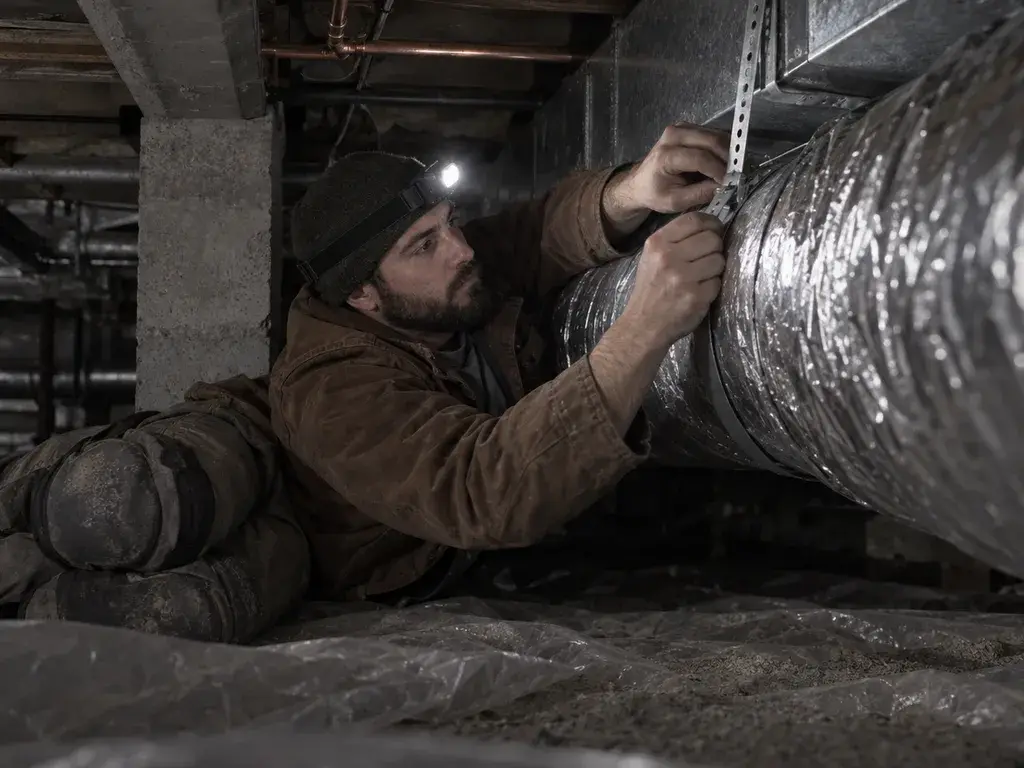
A room that never gets comfortable while the rest of the house is fine is usually a duct problem rather than an equipment problem. Name the room, and whether it happens in heating or in cooling, and an independent contractor can come out to Yellville and measure the airflow instead of guessing at it.
Cooling leads the year in Yellville, and the installer sizes the duct around the cooling load — where anybody sized it at all. That works in your favor more often than not: a system with a furnace moves less air in heating than it moves in cooling, and a heat pump moves the same air in both, so a run sized to carry the house through August usually carries it through the few cold weeks either way.
The short winter decides where the loss lands rather than whether there is one. A joint in a vented crawl space or an unconditioned attic leaks at the same rate in every month of the year; here it leaks through a cooling season that runs most of the year and a heating season measured in weeks. So almost everything a duct leak costs here is written in summer, and the time to get a contractor under the house is before that season rather than in the middle of it.
A return that leaks into an attic or a crawl space pulls outdoor air into the system at whatever the dew point outside happens to be, and the coil deals with that air before it deals with any room. In winter it is the heating side that pays for the same leak, and no room feels wrong in either season while it happens. Most of what the coil does in this climate is still temperature rather than moisture, so the temperature split measured across it reads mostly as airflow — one reading at the air handler is worth more than an afternoon of opening and closing registers.
Yellville, AR in numbers
| Days a year with a low of 32°F or colder | 73 | NOAA 1991–2020 normals, station 15 miles away |
|---|---|---|
| Days a year with a low of 20°F or colder | 17 | NOAA 1991–2020 normals |
| Average July dew point | 68°F | PRISM 1991–2020 normals |
| Median year homes were built | 1975 | Census ACS 2019–2023 |
| Households | 480 | Census ACS 2019–2023 |
| County | Marion County | Census Bureau |
| Federal minimum for a new split central AC | 14.3 SEER2 under 45,000 Btu/h (Southeast) | DOE, 2023 standard |
Duct problems do not fix themselves
The cold room is what gets reported, and it is the smaller half of what is happening. A restricted return or a collapsed run raises the pressure the blower has to work against, and the blower works against it every hour the system runs — in the rooms that are fine as much as in the room that is not.
Signs it is time to call
- A room has never been comfortable since the system was replaced.
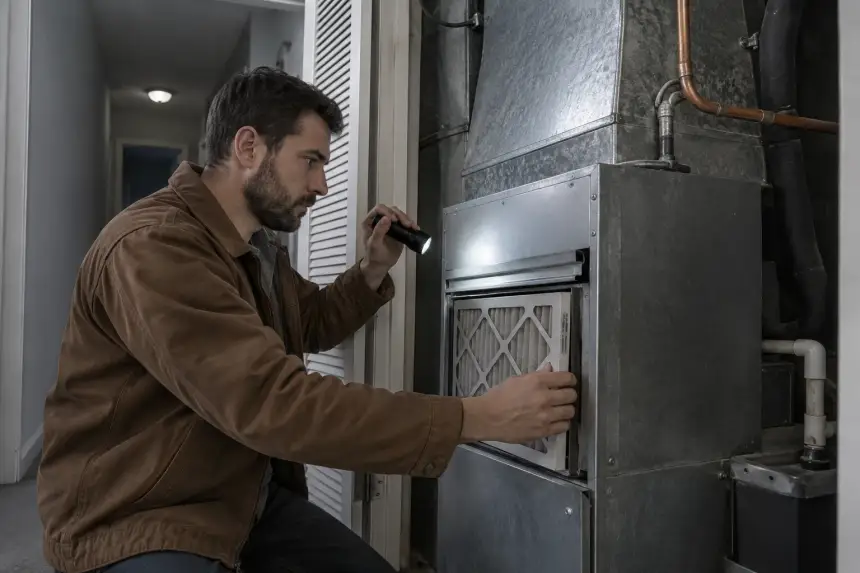
- A return grille whistles or roars, or the filter bows inward when the blower starts.
- Ice on the line at the air handler, or the system shutting itself off and starting again within the hour.
- The figure
- Set by the contractor and said before the work starts. This site never quotes and has no part in it. If a technician cannot say what the visit covers before beginning, that is the moment to stop.
- The call
- Describing what the system is doing commits you to nothing. Nothing is booked until you say so.
- Coverage
- By town, not by region. Yellville and the towns around it, and it shifts with who is taking calls at the hour you ring.
What the visit involves
- 01
The diagnosis
At the thermostat first, then at the furnace or the condenser, in the order the equipment runs. What the system is doing is established before any part is named.
- 02
The finding, out loud
What failed, whether it is the fault or a symptom of another one, and whether the repair suits the age of the system. A diagnostic visit is usually charged separately from the repair — ask whether it is credited if the work goes ahead, because that differs from one contractor to the next.
- 03
The repair
Agreed with the contractor before it starts. Where a part has to be ordered, a technician says so rather than leaving the system apart.
What to have ready when you call
- 01Which rooms are wrong, and whether it is in heating, in cooling, or both — that one answer narrows it before anybody arrives.
- 02The filter size, and how long the one in the slot has been there, and whether any register or damper has been closed.
- 03Where the duct runs — a basement, a vented crawl space, an attic, or entirely inside the house.
Do not go around opening and closing registers before the visit — a technician measures the system as it actually runs, and one damper moved this morning shifts every reading this afternoon.
Ductwork in Yellville: questions
How old are the homes in Yellville?
Half the homes in Yellville were built before 1975, by the Census Bureau's 2019–2023 American Community Survey. Detached houses make up most of the housing. Equipment in houses of that age is often on its second set, and the install date on the label decides whether parts are still made.
How humid are summers in Yellville?
The July dew point in Yellville averages 68°F, by the PRISM 1991–2020 climate normals. In air that wet an oversized air conditioner cools the house fast, shuts off before it has dried the air, and leaves rooms cool and clammy, which is why sizing starts with a load calculation for the house.
How efficient must a new air conditioner in Yellville be?
Arkansas is in DOE's Southeast region, where a split central air conditioner under the 2023 standard has to rate at least 14.3 SEER2 below 45,000 Btu/h. The Southeast rule goes by installation, so a unit below the standard may not be connected after January 1, 2023, whenever it was built.