Valle Verde, TX
Heat Pump Repair and Replacement in Valle Verde, TX
A heat pump in Valle Verde, TX works in both seasons, so its repair or replacement starts with how it behaves in each. Valle Verde averages 2 days a year with a low of 32°F or colder and almost none at 20°F or colder (NOAA 1991–2020 normals, station 19 miles away). The federal minimum for a split heat pump made since January 1, 2023 is 14.3 SEER2 in cooling and 7.5 HSPF2 in heating, nationwide.
(888) 217-3739Texas contractors. No obligation for the call.
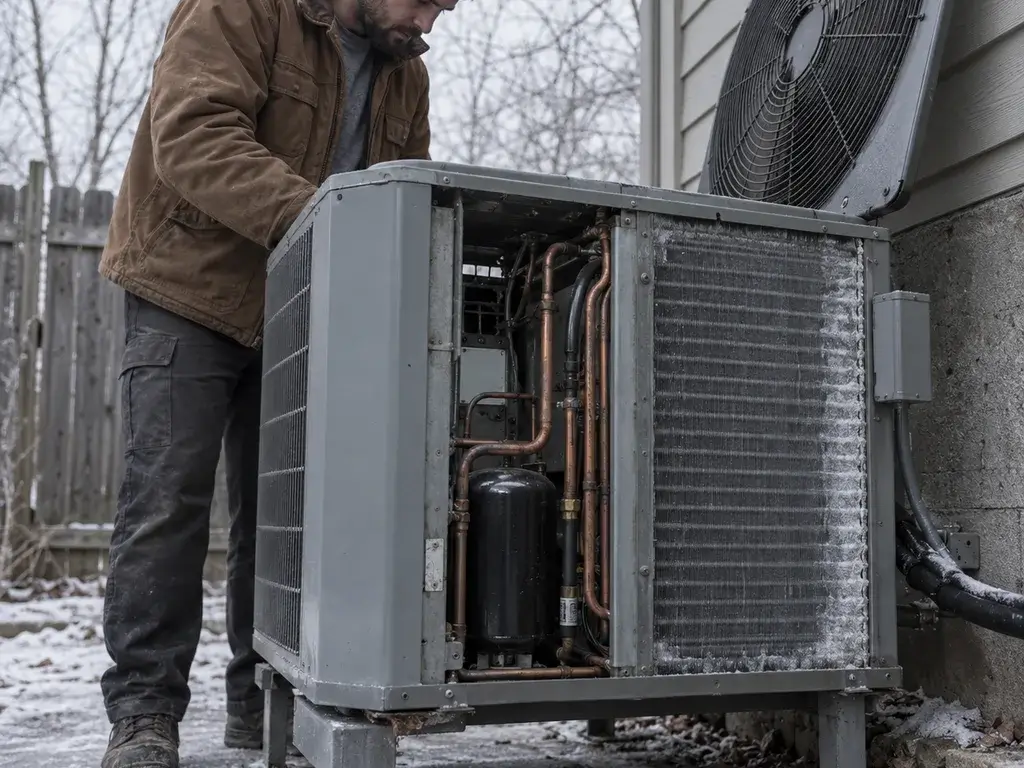
A heat pump blowing air that feels cool in winter is usually working as designed, and a heat pump that sits on auxiliary heat for hours in mild weather usually is not. Say what the thermostat is showing and a heating and cooling contractor can come out to Valle Verde and tell the two apart.
In Valle Verde the cooling season is the year and the heating season is a handful of mornings. What a no-heat call means here depends on what else is in the house: where there is a furnace, the heat pump has something to hand the load to, and where there is none — and in this climate plenty of houses have none — the only thing behind it is a bank of electric resistance strips. That is the first thing a technician asks about, because there is no second appliance to switch to.
The backup that goes in matches the winter this place actually has, which is the sensible way round and has one consequence worth knowing: a strip bank put in for a mild January holds less in reserve than the one the same house would get further north. A freeze that would be unremarkable further north finds that limit, and the house falls behind while the outdoor unit runs and tests fine. The question then is not what broke but whether anything did, and that is a measurement rather than a guess.
A heat pump has to be sized for two different jobs, and in a July this wet the two pull in opposite directions. Size it for the coldest night and it is too large for the cooling season: it drops the temperature, shuts off, and never runs long enough to pull water out of the air, so the thermostat reads 74°F and the house still feels damp. This is the point where a single-stage machine runs out of options, and it is the argument for a compressor that modulates rather than one that is simply larger — long, slow run cycles are what dehumidify. Ask what the sizing was based on: a measurement of the house, with the heating load and the cooling load worked out separately.
Valle Verde, TX in numbers
| Days a year with a low of 32°F or colder | 2 | NOAA 1991–2020 normals, station 19 miles away |
|---|---|---|
| Days a year with a low of 20°F or colder | fewer than one | NOAA 1991–2020 normals |
| Average July dew point | 71°F | PRISM 1991–2020 normals |
| County | Webb County | Census Bureau |
| Federal minimum for a new split central AC | 14.3 SEER2 under 45,000 Btu/h (Southeast) | DOE, 2023 standard |
Heat pumps do not fix themselves
The parts that cycle fail first, and they rarely fail alone. A run capacitor that has lost capacitance does not shut the compressor down — it raises the current the compressor draws every minute it runs, and the heat that comes with it. A heat pump asks for that on both sides of the year, where an AC only ever runs to cool, so the part that fails at the end of it is not the capacitor. A capacitor is a part; a compressor is a large fraction of the machine, and on a system installed before 2010 that is where the conversation turns to replacement.
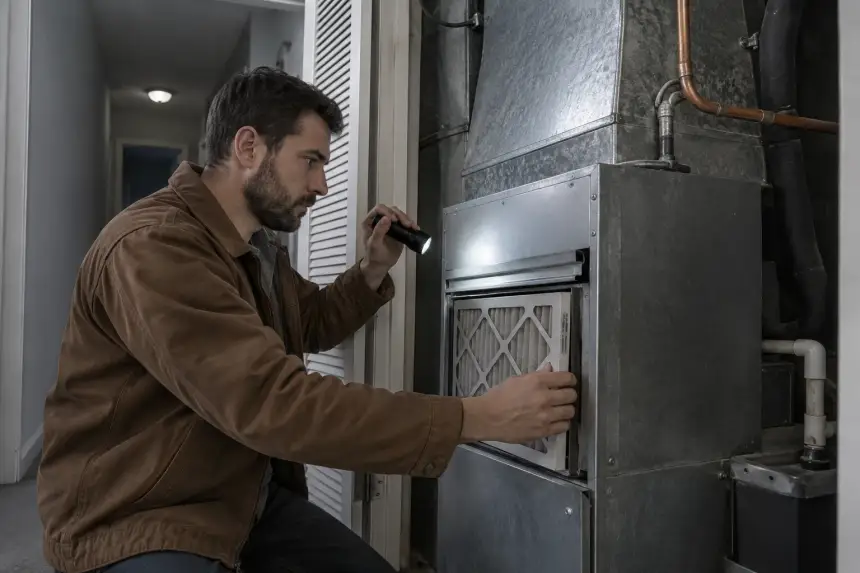
When to stop and call
- Ice covers the outdoor coil and the defrost cycles are not clearing it.
- The thermostat sits on auxiliary or emergency heat for hours while it is mild outside.
- Refrigerant was added in an earlier season and the system is behaving the same way again.
- The license
- Held by the contractor, not by this site, and issued where the work happens — Texas licenses at state level, at city level or not at all depending on the trade and the town. Ask for the number and the name it is held under: a trading name and the licensed entity are often not the same.
- The figure
- Set by the contractor and said before the work starts. This site never quotes and has no part in it. If a technician cannot say what the visit covers before beginning, that is the moment to stop.
- The call
- Describing what the system is doing commits you to nothing. Nothing is booked until you say so.
What happens on the visit
- 01
The diagnosis
At the thermostat first, then at the furnace or the condenser, in the order the equipment runs. What the system is doing is established before any part is named.
- 02
The finding, out loud
What failed, whether it is the fault or a symptom of another one, and whether the repair suits the age of the system. A diagnostic visit is usually charged separately from the repair — ask whether it is credited if the work goes ahead, because that differs from one contractor to the next.
- 03
What happens after
A system that failed once in a season often fails again in it. Whether that is the same fault or a second one is worth asking while the technician is still there.
What to have ready when you call
- 01That it is a heat pump, and what the backup is — electric, or a gas furnace on the same ducts, and not knowing is a fair answer.
- 02What the thermostat is set to, what it is reading, and whether it shows auxiliary or emergency heat.
- 03Roughly what year it went in, and the refrigerant from the outdoor data plate — R-410A on most systems in service, R-454B on recent ones.
If the house has gone cold, emergency heat is what that setting is for — say on the phone that you switched to it, because it locks out the compressor, and the fault a technician needs to watch stops happening while it is on.
Heat Pumps in Valle Verde: questions
How many freezing days does Valle Verde have?
Valle Verde averages 2 days a year with a low of 32°F or colder and almost none at 20°F or colder, by the 1991–2020 climate normals for a NOAA station 19 miles away. Heating is a handful of mornings here, so a heat pump spends nearly the whole year cooling.
What is the July dew point in Valle Verde?
The July dew point in Valle Verde averages 71°F, by the PRISM 1991–2020 climate normals. In air that wet an oversized air conditioner cools the house fast, shuts off before it has dried the air, and leaves rooms cool and clammy, which is why sizing starts with a load calculation for the house.
Is a new R-410A system still allowed in Valle Verde?
Under federal rules, yes, if the equipment was made or imported before January 1, 2025: an EPA rule that took effect on July 27, 2026 removed the January 1, 2026 installation deadline for that stock. Equipment made since January 1, 2025 is charged with R-454B or R-32 instead, and an outdoor unit built for those is not a listed match for an indoor coil built for R-410A.
Other services in Valle Verde
Heat Pumps nearby