Morse Bluff, NE
AC Repair in Morse Bluff, NE
Air conditioner repair in Morse Bluff, NE separates two faults that look the same from the thermostat: a system that runs without cooling and one that will not start. The July dew point in Morse Bluff averages 65°F (PRISM 1991–2020 normals), so an air conditioner here removes moisture as well as heat. Half the homes in Morse Bluff were built before 1938 (Census ACS 2019–2023), so in many of them the heating and cooling equipment has been replaced at least once while the ducts and the flue have not. An AC made before 2010 may still hold R-22, unproduced since January 1, 2020, while one made from 2010 through 2024 most likely holds R-410A, which new equipment has not used since January 1, 2025.
(888) 217-3739Nebraska contractors. No obligation for the call.
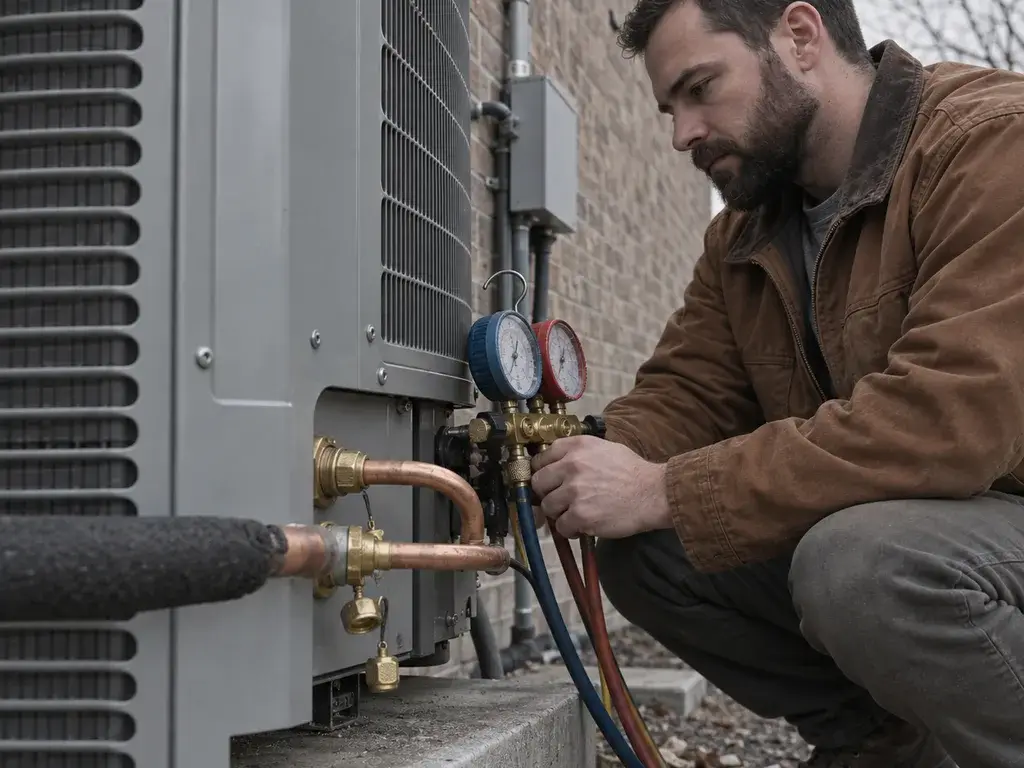
An air conditioner that runs without cooling and one that will not start at all are two different faults, and from the thermostat they look the same. Say which one it is and an independent contractor can come out to Morse Bluff and settle it at the unit rather than at the thermostat.
Cooling season in Morse Bluff is short, and a short season breaks things in its own way.
The AC here runs a few weeks a year and stands idle for the rest of it. Run hours are what wear a compressor out, so the machine is often younger in service than its install date suggests, and nobody has had a reason to look at it since. What gives out instead is what ages by sitting: the run capacitor, the contactor, and a condenser coil that has spent the cold months collecting whatever blew against it.
A heat pump in a winter like this one has backup heat behind it, and where that backup is electric resistance strips it can hide a cooling fault for a whole winter. A heat pump low on refrigerant loses heating capacity first; the strips make up the difference, the house stays warm, and the only thing that records it is the electric bill. Come July the same low charge has nothing to fall back on — which is why a summer call that begins with "it has never really cooled" is often a fault that was already there in February.
Morse Bluff, NE in numbers
| Days a year with a low of 32°F or colder | 147 | NOAA 1991–2020 normals, station 15 miles away |
|---|---|---|
| Days a year with a low of 20°F or colder | 73 | NOAA 1991–2020 normals |
| Average July dew point | 65°F | PRISM 1991–2020 normals |
| Median year homes were built | 1938 | Census ACS 2019–2023 |
| Households | 46 | Census ACS 2019–2023 |
| County | Saunders County | Census Bureau |
| Federal minimum for a new split central AC | 13.4 SEER2 (North region) | DOE, 2023 standard |
What the hardware-store fix does and does not do
The hard-start kit is not a gimmick, and it does a real job — it adds torque for the half-second a compressor needs to break away, and a technician fits one on purpose. It diagnoses nothing. A compressor that started without help last summer and needs help this one has changed, and the kit lets it go on starting while whatever changed carries on. Fitted after a measurement it buys time deliberately; fitted instead of one, it hides the reading that would have said how much time there is.
An AC tune-up before the summer
The time for an AC tune-up in Morse Bluff is before the first hot week, not during it, for the plain reason that every air conditioner in town gets its first hard test on the same afternoon. The parts that give out first — the run capacitor, the contactor, the condenser fan motor — wear through the months they spend idle as much as through the months they spend working.
When to stop and call
- The breaker has tripped more than once. Resetting it again is the response that makes it worse.
- There is ice on the copper line or on the indoor coil in hot weather.
- The system has been topped up with refrigerant before. A second recharge is a leak, not a service.
- The license
- Held by the contractor, not by this site, and issued where the work happens — Nebraska licenses at state level, at city level or not at all depending on the trade and the town. Ask for the number and the name it is held under: a trading name and the licensed entity are often not the same.
- The figure
- Set by the contractor and said before the work starts. This site never quotes and has no part in it. If a technician cannot say what the visit covers before beginning, that is the moment to stop.
- The call
- Describing what the system is doing commits you to nothing. Nothing is booked until you say so.
What the visit involves
- 01
The diagnosis
At the thermostat first, then at the furnace or the condenser, in the order the equipment runs. What the system is doing is established before any part is named.
- 02
The finding, out loud
What failed, whether it is the fault or a symptom of another one, and whether the repair suits the age of the system. A diagnostic visit is usually charged separately from the repair — ask whether it is credited if the work goes ahead, because that differs from one contractor to the next.
- 03
The repair
Agreed with the contractor before it starts. Where a part has to be ordered, a technician says so rather than leaving the system apart.
Before you call: what to have ready
- 01What the system is — central air with a furnace, a heat pump, or a ductless mini-split.
- 02Roughly when it went in, and what the data plate on the outdoor unit says it runs on — R-22, R-410A, R-454B or R-32, printed on the metal label.
- 03Whether the air at the vents is cold but weak, or moving normally and not cold — the two point at different halves of the system.
If there is ice anywhere on the system, switch the cooling off at the thermostat and leave the fan running: a technician cannot measure anything through a block of ice. A coil that has iced over takes a few hours to clear with the fan running, and about one day with the system off altogether — which is why the fan stays on.
AC Repair in Morse Bluff: questions
What is the July dew point in Morse Bluff?
The July dew point in Morse Bluff averages 65°F, by the PRISM 1991–2020 climate normals. In air that wet an oversized air conditioner cools the house fast, shuts off before it has dried the air, and leaves rooms cool and clammy, which is why sizing starts with a load calculation for the house.
How old are the homes in Morse Bluff?
Half the homes in Morse Bluff were built before 1938, by the Census Bureau's 2019–2023 American Community Survey. Detached houses make up almost all of the housing. In houses that age the furnace or air conditioner has usually been replaced at least once, and the ducts and the flue are often older than the equipment.
Is a new R-410A system still allowed in Morse Bluff?
Federally, yes, for equipment made or imported before January 1, 2025: the EPA dropped the January 1, 2026 installation deadline for that stock in a rule effective July 27, 2026. Equipment made since January 1, 2025 is charged with R-454B or R-32 instead, and an outdoor unit built for those is not a listed match for an indoor coil built for R-410A.
Other services in Morse Bluff
AC Repair nearby