Lincoln, AR
AC Repair in Lincoln, AR
Air conditioner repair in Lincoln, AR separates two faults that look the same from the thermostat: a system that runs without cooling and one that will not start. The July dew point in Lincoln averages 68°F (PRISM 1991–2020 normals), so an air conditioner here removes moisture as well as heat. Half the homes in Lincoln were built before 1979 (Census ACS 2019–2023). An AC made before 2010 may still hold R-22, unproduced since January 1, 2020, while one made from 2010 through 2024 most likely holds R-410A, which new equipment has not used since January 1, 2025.
(888) 217-3739Arkansas contractors. No obligation for the call.
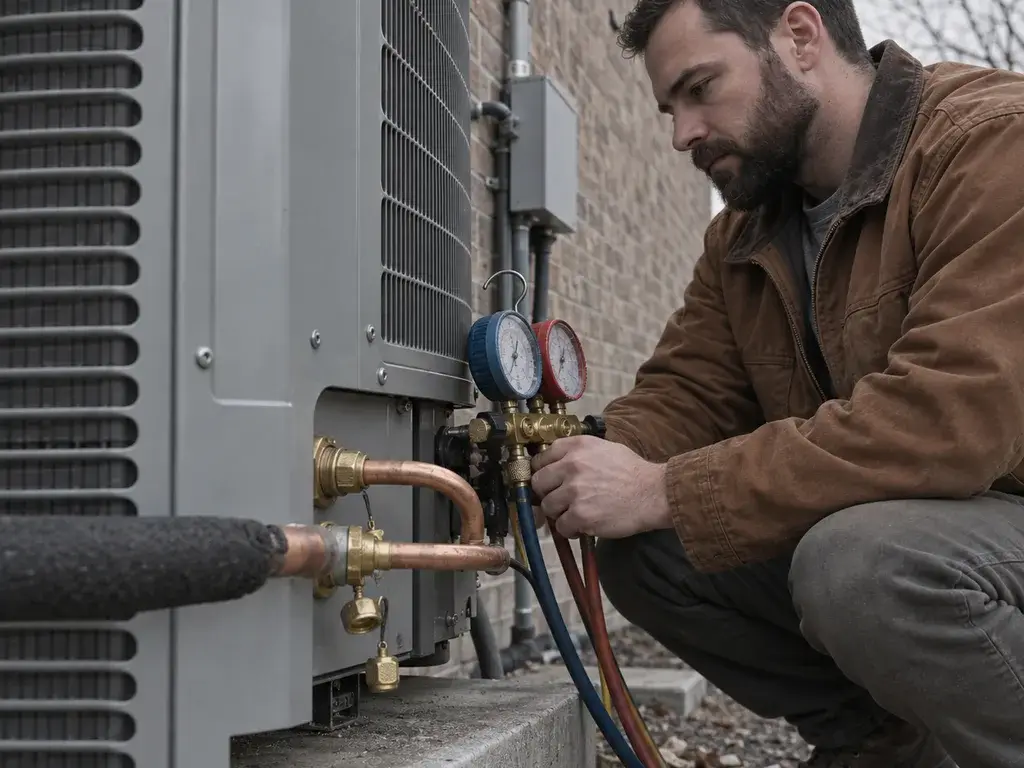
An air conditioner that runs without cooling and one that will not start at all are two different faults, and from the thermostat they look the same. Say which of the two is happening and an independent contractor can come out to Lincoln and settle it at the unit rather than at the thermostat.
Winter in Lincoln comes in stretches of a few weeks rather than as a season, and the cooling side is what carries the year.
Almost every call here comes back to the outdoor unit, because the cooling side is the half that gets used. Run hours wear out a compressor, a contactor and an outdoor fan motor, so summers worked says more about a compressor than the year on the data plate does: a system installed in 2011 that has cooled through every summer since has more behind it than the install date alone shows. Where the outdoor unit heats the house too, as a heat pump does, no part of the year gives it a rest.
Summer here is humid without being tropical, so the AC works on both halves of the job at once: temperature, and the water in the air. Neither half leads, which is why the complaint itself is worth saying precisely on the phone. A house that gets down to the set temperature and still feels damp is reporting the water half: the charge, the amount of air crossing the coil, or a system that satisfies the thermostat before it has dried anything. A house that never reaches the set temperature at all on a hot afternoon is reporting capacity, and a technician goes after that with a different set of checks. Indoors the two sound like one complaint; at the coil they separate.
Lincoln, AR in numbers
| Days a year with a low of 32°F or colder | 77 | NOAA 1991–2020 normals, station 13 miles away |
|---|---|---|
| Days a year with a low of 20°F or colder | 19 | NOAA 1991–2020 normals |
| Average July dew point | 68°F | PRISM 1991–2020 normals |
| Median year homes were built | 1979 | Census ACS 2019–2023 |
| Households | 989 | Census ACS 2019–2023 |
| County | Washington County | Census Bureau |
| Federal minimum for a new split central AC | 14.3 SEER2 under 45,000 Btu/h (Southeast) | DOE, 2023 standard |
What the hardware-store fix does and does not do
The can of refrigerant with sealant in it is the one to leave on the shelf. The sealant is made to harden where it meets air, and inside a system it hardens in the metering device, the filter drier and the recovery equipment — and it does not come back out of a recovery machine, which is why a system that has had it is a harder system to get worked on. The gauge on the can cannot tell a low charge from a dirty coil, a blocked filter or a restricted metering device, and all four read low on the same needle. A technician weighs the charge in against a measurement instead of adding it until the air feels colder. Refrigerant for a home system is not a retail purchase either: EPA rules restrict the sale of it to certified technicians, and what has turned up on the shelf as a drop-in for R-22 has at times been a flammable hydrocarbon blend.
An AC tune-up before the summer
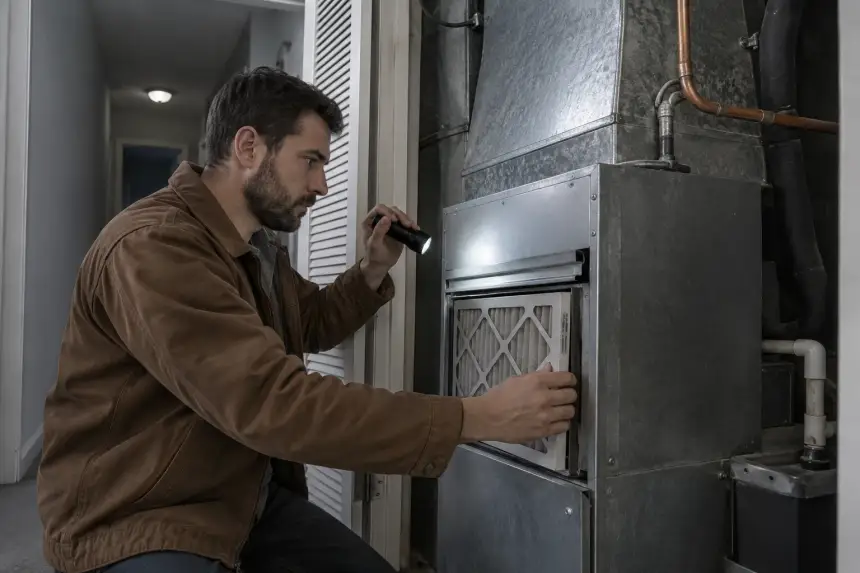
An AC maintenance visit covers a specific list: the outdoor coil cleaned so it can shed heat, the capacitor tested against its rating, the contactor looked at for pitting, refrigerant pressures read against the manufacturer's chart, the temperature split measured across the indoor coil, and the condensate drain and pan cleared. A system that is low on refrigerant has a leak somewhere, and topping it up without finding the leak buys a season at most.
When to stop and call
- There is ice on the copper line or on the indoor coil in hot weather.
- The outdoor unit hums but the fan does not turn.
- Water is standing under the indoor unit, or there is a burning smell from either half.
- The figure
- Set by the contractor and said before the work starts. This site never quotes and has no part in it. If a technician cannot say what the visit covers before beginning, that is the moment to stop.
- The call
- Describing what the system is doing commits you to nothing. Nothing is booked until you say so.
- Coverage
- By town, not by region. Lincoln and the towns around it, and it shifts with who is taking calls at the hour you ring.
What happens on the visit
- 01
The finding, out loud
What failed, whether it is the fault or a symptom of another one, and whether the repair suits the age of the system. A diagnostic visit is usually charged separately from the repair — ask whether it is credited if the work goes ahead, because that differs from one contractor to the next.
- 02
The repair
Agreed with the contractor before it starts. Where a part has to be ordered, a technician says so rather than leaving the system apart.
- 03
What happens after
A system that failed once in a season often fails again in it. Whether that is the same fault or a second one is worth asking while the technician is still there.
What to have ready when you call
- 01What the system is — central air with a furnace, a heat pump, or a ductless mini-split.
- 02What the outdoor unit is doing: silent, humming, fan spinning, or tripping the breaker.
- 03Whether the air at the vents is cold and weak, or moving normally at room temperature — the two point at different halves of the system.
If there is ice anywhere on the system, switch the cooling off at the thermostat and leave the fan running: a technician cannot measure anything through a block of ice. A coil that has iced over takes a few hours to clear with the fan running, and about one day with the system off altogether — which is why the fan stays on.
AC Repair in Lincoln: questions
How humid are summers in Lincoln?
The July dew point in Lincoln averages 68°F, by the PRISM 1991–2020 climate normals. In air that wet an oversized air conditioner cools the house fast, shuts off before it has dried the air, and leaves rooms cool and clammy, which is why sizing starts with a load calculation for the house.
When were most houses in Lincoln built?
Half the homes in Lincoln were built before 1979, by the Census Bureau's 2019–2023 American Community Survey. Detached houses make up almost all of the housing. Equipment in houses of that age is often on its second set, and the install date on the label decides whether parts are still made.
Can a contractor in Lincoln still install an R-410A system?
Federally, yes, for equipment made or imported before January 1, 2025: the EPA dropped the January 1, 2026 installation deadline for that stock in a rule effective July 27, 2026. Equipment made since January 1, 2025 is charged with R-454B or R-32 instead, and an outdoor unit built for those is not a listed match for an indoor coil built for R-410A.
Other services in Lincoln
AC Repair nearby