Frankfort, OH
AC Replacement and Installation in Frankfort, OH
AC replacement in Frankfort, OH is sized from the house and its climate, not from the tonnage stamped on the old condenser. Frankfort has an average July dew point of 65°F (PRISM 1991–2020 normals), so an air conditioner here removes moisture as well as heat. Half the homes in Frankfort were built before 1965 (Census ACS 2019–2023), so in many of them the heating and cooling equipment has been replaced at least once while the ducts and the flue have not. The federal floor for a split central air conditioner made since January 1, 2023 and sold for Ohio is 13.4 SEER2, the North region's standard.
(888) 217-3739Ohio contractors. No obligation for the call.
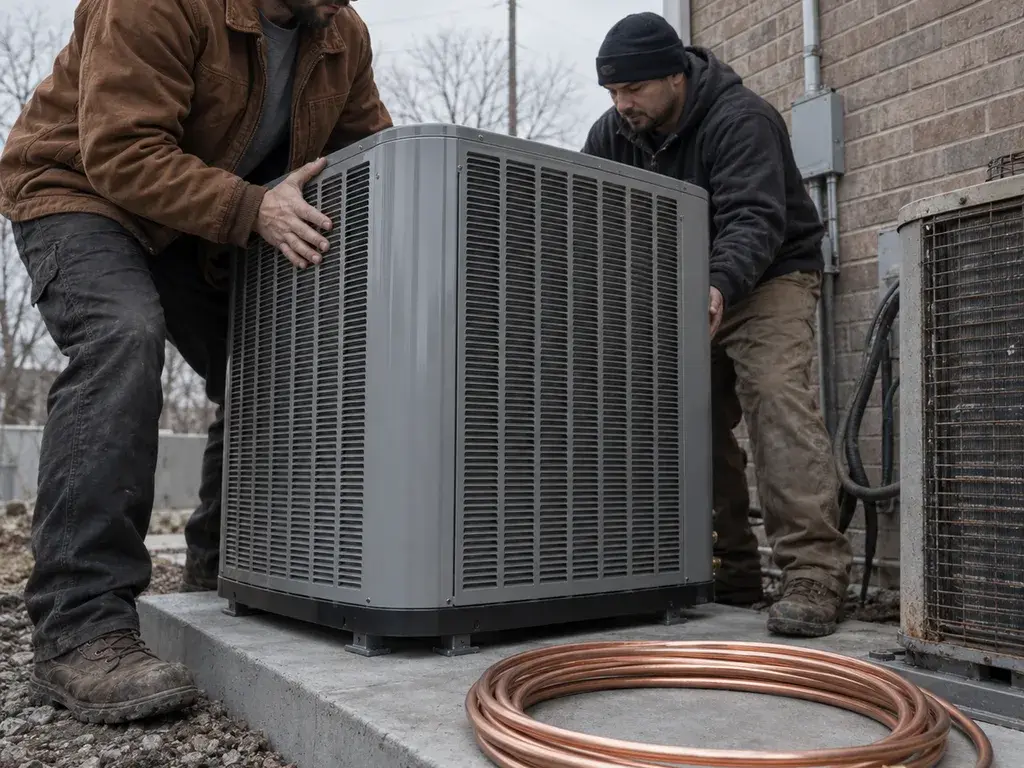
An air conditioner that gives up on a hot afternoon has not automatically reached the end of its life, and what settles it is age, what failed, and what the system is charged with. Say what year the system went in and what it has started doing, and an independent contractor can come out to Frankfort and size the replacement from the house rather than from the box being carried out.
Summer and winter both make real demands on the system in Frankfort, and both age at the same rate because of it. The air conditioner carries the summer, the heating side carries the winter, and neither one gets a long idle stretch in which a fault can sit unnoticed.
The two machines usually went in on the same day, and that shapes the order of the work as much as their condition does. Where the indoor coil sits on top of a furnace, a contractor reaching one has to open the other, so replacing the cooling half in September and the heating half in March means opening that cabinet twice in one year. The two are also rated as a pair, and the half left in place sets what the new half can actually deliver — which is why a mismatch can end the manufacturer's parts coverage on equipment that has not run a season yet.
A replacement here has to suit two different summers, because Frankfort gets both of them. There are weeks when the air is heavy and the coil spends real time taking water out of it, and there are longer stretches when it is not and the job is temperature alone. A contractor sizes the equipment for the heavy weeks, which is right, and the system then spends most of its hours well below the load it was chosen for. June and September are where that shows: the temperature is mild, so the system barely runs, and the moisture has not gone anywhere — a house can sit damp in a month nobody would call hot. That is the thing to raise early, because what a system does on a mild wet day follows from what was ordered rather than from how anyone sets it afterwards.
Frankfort, OH in numbers
| Days a year with a low of 32°F or colder | 114 | NOAA 1991–2020 normals, station 10 miles away |
|---|---|---|
| Days a year with a low of 20°F or colder | 39 | NOAA 1991–2020 normals |
| Average July dew point | 65°F | PRISM 1991–2020 normals |
| Median year homes were built | 1965 | Census ACS 2019–2023 |
| Households | 618 | Census ACS 2019–2023 |
| County | Ross County | Census Bureau |
| Federal minimum for a new split central AC | 13.4 SEER2 (North region) | DOE, 2023 standard |
Before you try the store-bought fix
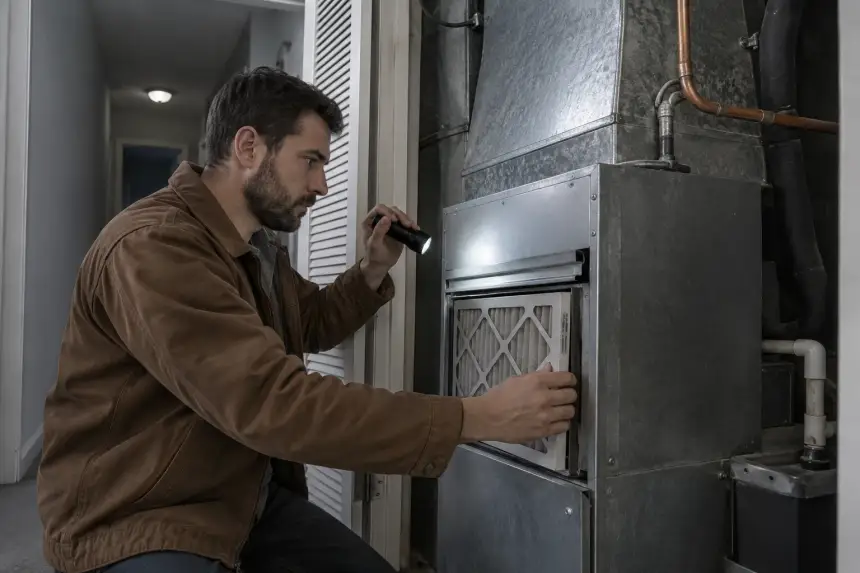
A new filter is the one item on that shelf that is not a repair pretending to be one, and it is worth being exact about what it reaches. A blocked filter starves the coil of air, the coil ices, and a coil that ices repeatedly sends liquid refrigerant back to the compressor — a real failure with an avoidable cause, and a clean filter removes that cause. What it does not reach is what has already happened: a compressor that has taken liquid, a coil that is iced now, or a charge that is low because the system is leaking. Ice that returns on a clean filter is not a filter problem at all, and at that point the filter has told you what it can.
When to stop and call
- You have read R-22 on the outdoor data plate, and the system is no longer holding the house.
- The compressor hums and then trips the breaker, and resetting it is the one thing you can do that makes it worse.
- Ice comes back on the line or the coil after you have put a clean filter in.
- The license
- Held by the contractor, not by this site, and issued where the work happens — Ohio licenses at state level, at city level or not at all depending on the trade and the town. Ask for the number and the name it is held under: a trading name and the licensed entity are often not the same.
- The figure
- Set by the contractor and said before the work starts. This site never quotes and has no part in it. If a technician cannot say what the visit covers before beginning, that is the moment to stop.
- The call
- Describing what the system is doing commits you to nothing. Nothing is booked until you say so.
What happens on the visit
- 01
The finding, out loud
What failed, whether it is the fault or a symptom of another one, and whether the repair suits the age of the system. A diagnostic visit is usually charged separately from the repair — ask whether it is credited if the work goes ahead, because that differs from one contractor to the next.
- 02
The repair
Agreed with the contractor before it starts. Where a part has to be ordered, a technician says so rather than leaving the system apart.
- 03
What happens after
A system that failed once in a season often fails again in it. Whether that is the same fault or a second one is worth asking while the technician is still there.
What to have ready when you call
- 01Roughly when the system went in, and what refrigerant it is charged with — the model number is worth having in front of you too.
- 02What happens when the system runs — not cooling at all, cooling weakly, running without ever stopping, tripping the breaker, or icing over.
- 03The address and ZIP code, and how a technician gets to the outdoor unit — a locked gate or a dog in the yard changes the appointment.
Find the outdoor data plate and read it before you call — the model number and the refrigerant are printed on it, and those two lines decide most of what follows.
AC Replacement in Frankfort: questions
How humid are summers in Frankfort?
The July dew point in Frankfort averages 65°F, by the PRISM 1991–2020 climate normals. In air that wet an oversized air conditioner cools the house fast, shuts off before it has dried the air, and leaves rooms cool and clammy, which is why sizing starts with a load calculation for the house.
How old are the homes in Frankfort?
Half the homes in Frankfort were built before 1965, by the Census Bureau's 2019–2023 American Community Survey. Detached houses make up most of the housing. In houses that age the furnace or air conditioner has usually been replaced at least once, and the ducts and the flue are often older than the equipment.
Is there still a federal tax credit for a new air conditioner?
No. The 25C energy efficient home improvement credit ended for equipment installed after December 31, 2025, under the tax law signed on July 4, 2025. A quote that subtracts it is out of date, and any utility or state rebate is a separate program to ask the utility about.
Other services in Frankfort
AC Replacement nearby