Deweyville, UT
AC Repair in Deweyville
An air conditioner that runs without cooling and one that will not start at all are two different faults, and from the thermostat they look the same. Say which of the two is happening and an independent contractor can come out to Deweyville and settle it at the unit rather than at the thermostat.
(888) 217-3739Utah contractors. No obligation for the call.
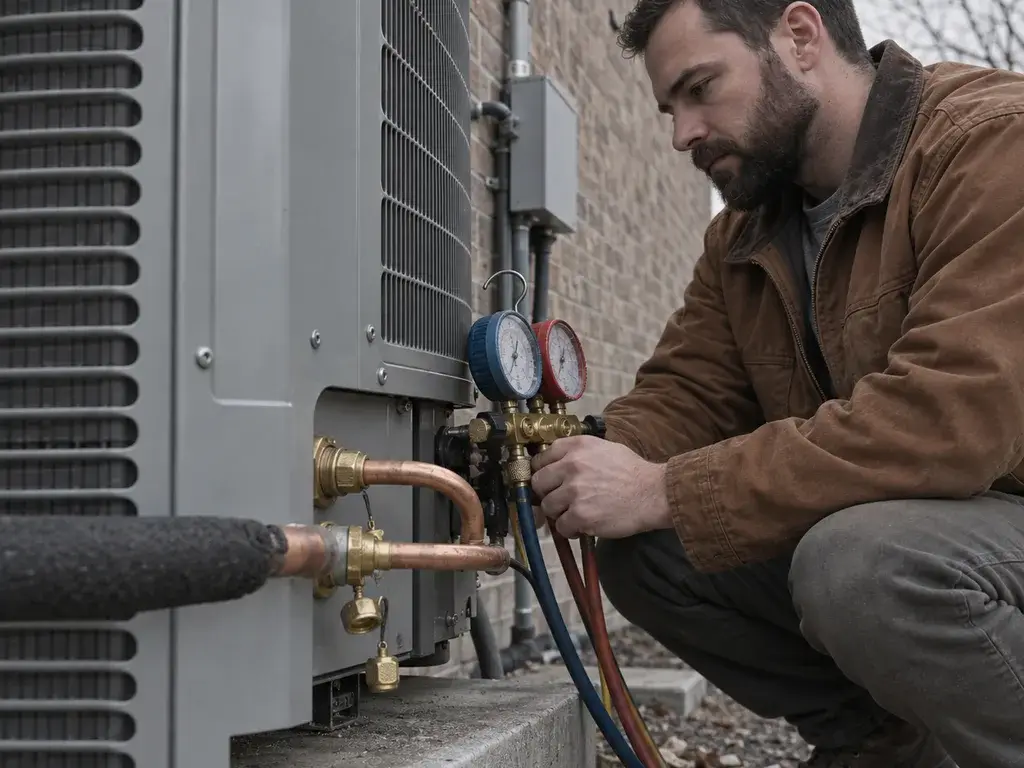
In Deweyville both halves of the system get a real season, and both of them age.
The cooling side works a full summer here rather than a handful of hot weeks, which puts real hours on the compressor, the outdoor fan motor and the contactor. The two halves rarely wear out together, and that is what makes a repair on a system past fifteen years a decision rather than a job: the heating side can have years left in it while the outdoor unit does not.
Where one blower and one set of ducts serve both seasons, which is the usual arrangement, the two systems are not really two machines, and that sorts a cooling fault before anyone opens anything. A house that heated normally through the winter and will not cool in July was running that shared half until spring, which points the question at the cooling side — the condenser, the contactor, the charge. A blower that was already struggling in the winter points the other way, and the summer complaint is the second symptom rather than the first.
Summer air here is dry enough that the AC has one job, moving heat, and almost none of its capacity goes into water. That shows up in the numbers: a healthy system in Deweyville produces a wider temperature split across the coil than the same system would in a humid climate, and a split that would look ordinary in a muggy town is a finding here. The penalty for an oversized unit turns up somewhere else — it reaches the set temperature and shuts off, and the house is comfortable because nothing needed drying, so the machine pays for it rather than the people in it, in start cycles on a compressor that would rather run long and steady. A dry summer also means little rain to rinse the outdoor coil, so the fins collect a fine dry film that works like a blanket, and the capacity goes missing on exactly the afternoons it is wanted.
A heat pump in a winter like this one has backup heat behind it, and where that backup is electric resistance strips it can hide a cooling fault for a whole winter. A heat pump low on refrigerant loses heating capacity first; the strips make up the difference, the house stays warm, and the only thing that records it is the electric bill. In July the same low charge has no backup behind it — which is why a summer call that begins with "it has never really cooled" is often a fault that was already there in February.
Why ACs do not fix themselves
A run capacitor does not always fail outright. A weak one lets the compressor start, but start hard — and a compressor that starts hard pulls locked-rotor current for longer every time the thermostat calls. The capacitor is a small cylinder that rides on the van; the compressor is the part that decides whether the system is worth keeping at all. Leaving a weak capacitor in place to avoid a small repair is how a small repair turns into a replacement.
A working system does not consume refrigerant, so a charge that has to be topped up every season is leaving through a hole nobody has found. Oil leaves with it: oil circulates with the refrigerant and lubricates the compressor, so a system running low runs hot and under-lubricated at the same time. Each recharge buys less than the one before it, and the part it is protecting gets closer to the end.
Ice on the indoor coil or on the copper line is a symptom that then does damage of its own. A coil below freezing blocks its own airflow, which drops the pressure further, which makes more ice; what eventually reaches the compressor is liquid rather than vapor, and a compressor built to squeeze gas does not survive being asked to squeeze liquid. The right move is to switch it off — running it through the ice is not patience, it is the expensive half of the failure.
What the store-bought fix actually does
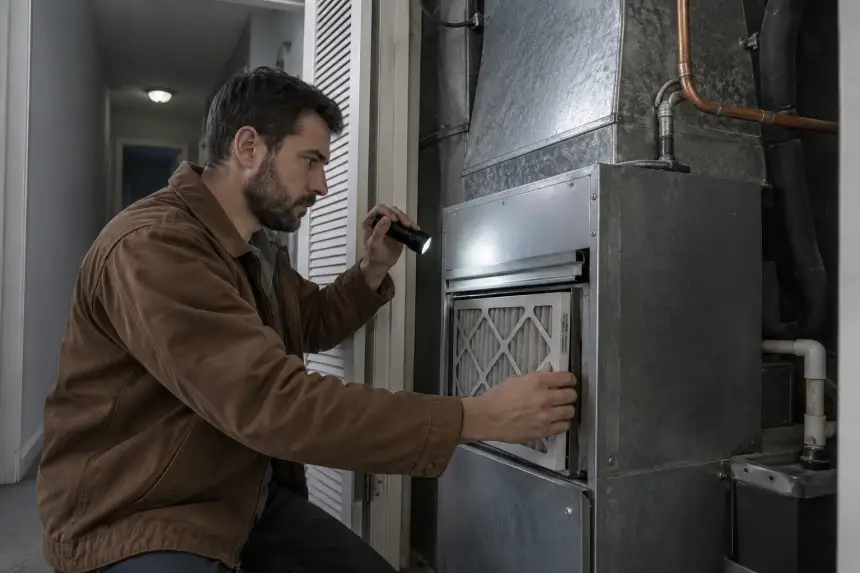
The filter is the one thing on the shelf that genuinely belongs to this fault, and being fair about it costs nothing: a filter gone gray stops enough air to freeze a coil, it is the first thing a technician checks for exactly that reason, and a system that iced up because of one wants it changed before anything else. A new filter reaches none of what sits on the other side of it: a charge that has leaked away, a capacitor that has drifted, an outdoor coil packed solid, a blower wheel silted up blade by blade. Nor does it clear the ice already on the coil, which needs the cooling off, the fan on and several hours. A system that froze with a clean filter in it has already ruled the filter out, and that is worth saying on the phone.
The can with sealant in it is the one that does damage. The sealant is made to harden where it meets air, and inside a system it hardens in the metering device, the filter drier and the recovery equipment — and it does not come back out of a recovery machine, which is why a system that has had it is a harder system to get worked on. The gauge on the can cannot tell a low charge from a dirty coil, a blocked filter or a restricted metering device, and all four read low on the same needle. A technician weighs the charge in against a measurement instead of adding it until the air feels colder. Refrigerant for a home system is not a retail purchase either: EPA rules restrict the sale of it to certified technicians, and what has turned up on the shelf as a drop-in for R-22 has at times been a flammable hydrocarbon blend.
A hard-start kit is a real part rather than a gimmick — it adds torque for the half-second a compressor needs to break away, and a technician fits one on purpose. What it does not do is diagnose anything. A compressor that started without help last summer and needs help this one has changed, and the kit lets it go on starting while whatever changed carries on. Fitted after a measurement it buys time deliberately; fitted instead of one, it hides the reading that would have said how much time there is.
When to stop and call
- The breaker has tripped more than once. Resetting it again is the response that makes it worse.
- There is ice on the copper line or on the indoor coil in hot weather.
- The outdoor unit hums but the fan does not turn.
- The system has been topped up with refrigerant before. A second recharge is a leak, not a service.
- Water is standing under the indoor unit, or there is a burning smell from either half.
- The license
- Held by the contractor, not by this site, and issued where the work happens — Utah licenses at state level, at city level or not at all depending on the trade and the town. Ask for the number and the name it is held under: a trading name and the licensed entity are often not the same.
- The figure
- Set by the contractor and said before the work starts. This site never quotes and has no part in it. If a technician cannot say what the visit covers before beginning, that is the moment to stop.
- The call
- Describing what the system is doing commits you to nothing. Nothing is booked until you say so.
- Coverage
- By town, not by region. Deweyville and the towns around it, and it shifts with who is taking calls at the hour you ring.
What the visit involves
- 01
The diagnosis
At the thermostat first, then at the furnace or the condenser, in the order the equipment runs. What the system is doing is established before any part is named.
- 02
The finding, out loud
What failed, whether it is the fault or a symptom of another one, and whether the repair suits the age of the system. A diagnostic visit is usually charged separately from the repair — ask whether it is credited if the work goes ahead, because that differs from one contractor to the next.
- 03
The repair
Agreed with the contractor before it starts. Where a part has to be ordered, a technician says so rather than leaving the system apart.
- 04
What happens after
A system that failed once in a season often fails again in it. Whether that is the same fault or a second one is worth asking while the technician is still there.
What to have ready when you call
- 01What the system is — central air with a furnace, a heat pump, or a ductless mini-split.
- 02Roughly when it was installed, and what the outdoor data plate says it is charged with — R-22, R-410A, R-454B or R-32, printed on the metal label.
- 03Both thermostat numbers — what it is set to and what it is reading.
- 04What the outdoor unit is doing: silent, humming, fan spinning, or tripping the breaker.
- 05Whether the air at the vents is cold but weak, or moving normally and not cold — the two point at different halves of the system.
Switch the cooling off at the thermostat and leave the fan running if there is ice anywhere on the system: a technician cannot measure anything through a block of ice. A coil that has iced over takes a few hours to clear with the fan running, and about one day with the system off altogether — which is why the fan stays on.
Other services in Deweyville
AC Repair nearby