Cranberry Lake, NY
Heating Repair in Cranberry Lake
No heat on a cold night comes down to a short list of faults, and the step where the sequence stops names the part. Say what heats the house, what the thermostat is asking for against what it says the room is, and what the equipment is actually doing, and a heating contractor who covers Cranberry Lake takes it from there.
(888) 217-3739New York contractors. No obligation for the call.
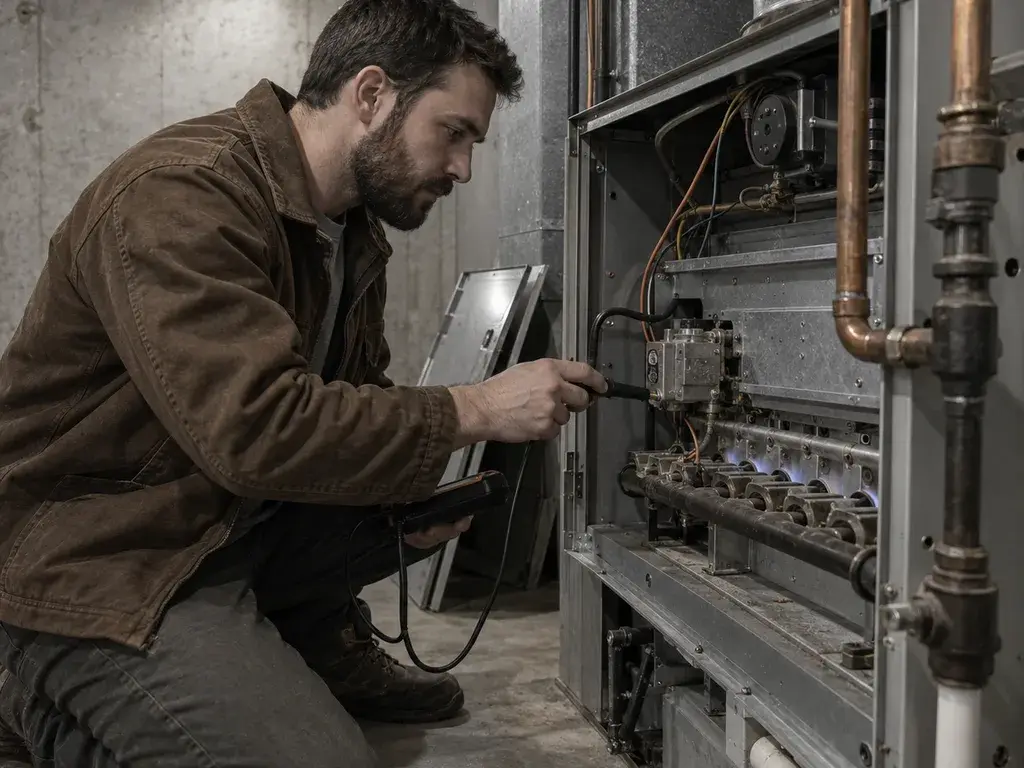
A winter this long makes heating the main system in a Cranberry Lake house rather than the second one, and a night without it is counted in hours rather than in inconvenience. A house that loses heat overnight in a cold snap has a plumbing question by morning, which is why this is a call worth making at the hour it happens rather than in the morning.
What a winter this long changes is which part gives up first. A furnace that has been firing since October reaches January with the hours on it, so what fails is usually the part that has been working rather than the part that was weakest when it went in: an ignitor has a certain number of starts in it, an inducer motor and a blower motor turn on bearings, and a flame sensor takes on a little more of what the flame leaves behind every cycle. What a cold snap adds is only the timing.
Where a heat pump does the heating, a cold snap puts it on its auxiliary heat strips — resistance heat, which a heat pump calls in below about 35°F, and a cold week spent on the strips turns up on the electric bill. The reason it turns into a repair question is that the strips can hide a fault: a heat pump that has stopped heating still leaves a warm house, because the strips take the whole load and the thermostat never complains. Often the first sign is the bill rather than the cold, and by then the system has been running the expensive half of itself for weeks.
Why heating faults do not fix themselves
A furnace that only runs after a reset is not a furnace that is working. Each lockout is a control board refusing to try again after a safety did not prove — the flame, the pressure switch or the limit — and a reset settles none of it. What a reset does change is the wear: a furnace short cycling through a cold week runs its ignition sequence dozens of times a day, and the ignitor and the inducer motor are the parts paying for it.
The one fault that changes the conversation entirely is a cracked heat exchanger. It is not a repair question alone — the gas utility red-tags the appliance and shuts the supply off, and it restores the supply only after a licensed contractor has worked on the furnace. The appliance does not come back by flipping a switch, and a tag pulled off the furnace takes the record of what was found with it.
That rule exists because of carbon monoxide, and it is also why a heating fault is worth a call in a warm week rather than the next cold one. A furnace misfiring in October is the same furnace in January, except that by then it runs every hour and the part has to be found in the middle of a cold snap.
What the store-bought fix actually does
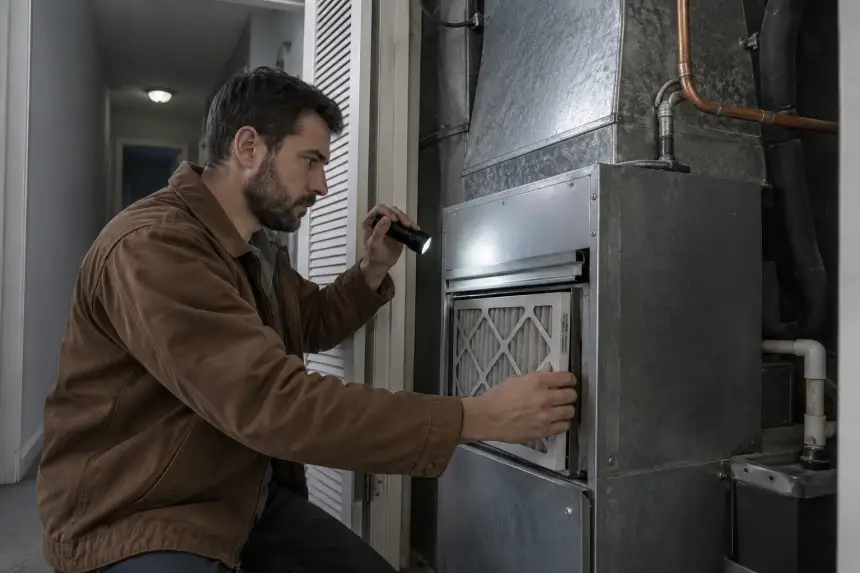
A new filter is the one item from a hardware store that ends a no-heat call outright, and it is fair to say so: a filter that has loaded up chokes the return, the heat exchanger cannot put its heat into air that is barely moving, the limit switch opens, and the furnace shuts itself down and short cycles. What a new filter cannot do is prove it was the fault. Where the furnace locks out again within a day of a new one going in, the restriction is somewhere past the filter, and a technician measures the temperature rise across the furnace to find where.
Cleaning the flame sensor is the other place where a hand and a rag do something, and it comes with a limit. A rod coated in what the flame leaves behind stops proving the flame, the gas valve closes a few seconds after it opens, and a rod wiped clean proves flame again. What it never answers is why the rod fouled: the coating comes off the flame itself, so a sensor that wants cleaning twice in one season is reporting combustion rather than dirt, and combustion is not a hardware-store question. An ignitor bought off a shelf is a different matter again — it is a stocked part, and it is also the part people replace twice, because an ignitor that glows and still does not light is pointing at the gas valve or the wiring to it rather than at itself.
Past those two, what the shop can sell stops reaching the fault. A thermostat is the purchase people make next, and on a cold night it usually adds a problem of its own: the old one comes off the wall before anyone writes down which wire sat on which terminal, and a no-heat call becomes a no-heat call with the controls in pieces. Electric heat plugged into a wall socket will bridge one night, and that is a fair use of it, though several units on one circuit trip the breaker — and a gas range with the oven door open is the one improvisation that puts combustion products into the room people are sleeping in.
When to stop and call
- The furnace locks out again within an hour of being reset.
- There is a smell of gas, or a carbon monoxide alarm has gone off — outside first, then the gas utility, then the repair call.
- There is a tag on the furnace and the gas supply has been shut off.
- The blower runs and the air never warms, or the thermostat is asking for heat while the reading keeps dropping.
- Water is standing at the base of the furnace, or the flue outside has iced over.
- The license
- Held by the contractor, not by this site, and issued where the work happens — New York licenses at state level, at city level or not at all depending on the trade and the town. Ask for the number and the name it is held under: a trading name and the licensed entity are often not the same.
- The figure
- Set by the contractor and said before the work starts. This site never quotes and has no part in it. If a technician cannot say what the visit covers before beginning, that is the moment to stop.
- The call
- Describing what the system is doing commits you to nothing. Nothing is booked until you say so.
- Coverage
- By town, not by region. Cranberry Lake and the towns around it, and it shifts with who is taking calls at the hour you ring.
What the visit involves
- 01
The diagnosis
At the thermostat first, then at the furnace or the condenser, in the order the equipment runs. What the system is doing is established before any part is named.
- 02
The finding, out loud
What failed, whether it is the fault or a symptom of another one, and whether the repair suits the age of the system. A diagnostic visit is usually charged separately from the repair — ask whether it is credited if the work goes ahead, because that differs from one contractor to the next.
- 03
The repair
Agreed with the contractor before it starts. Where a part has to be ordered, a technician says so rather than leaving the system apart.
- 04
What happens after
A system that failed once in a season often fails again in it. Whether that is the same fault or a second one is worth asking while the technician is still there.
What to have ready when you call
- 01Which system it is: a furnace, a boiler with radiators or baseboard, or a heat pump with electric backup.
- 02Roughly when it went in, plus the model and serial number from the data plate inside the cabinet door — the year is usually in the serial rather than printed as a date.
- 03The two thermostat numbers: the setting, and the reading it shows for the room — and whether the screen has gone blank, because a thermostat wired without a common wire runs off its battery, and a dead battery looks exactly like a dead furnace.
- 04What it is doing: silent, clicking and stopping, lighting and dropping out, or running with cold air at the vents.
- 05Whether the gas utility has already been to the house, and whether there is a tag on the appliance.
Leave the reset alone while you wait — each press relights a furnace that shut itself down for a reason, and the lockout it is holding is the first thing a technician reads.
Other services in Cranberry Lake
Heating Repair nearby