Chimney Point, CT
Furnace and Heating Repair in Chimney Point, CT
Furnace repair in Chimney Point, CT begins with what the system does when the thermostat calls for heat, and where in that sequence it quits. Chimney Point has, on average, 126 days a year with a low of 32°F or colder and 46 at 20°F or colder (NOAA 1991–2020 normals, station 7 miles away). When the gas utility finds a leak or an unsafe furnace it shuts the gas off and tags the appliance, and only a repair brings the gas back.
(888) 217-3739Connecticut contractors. No obligation for the call.
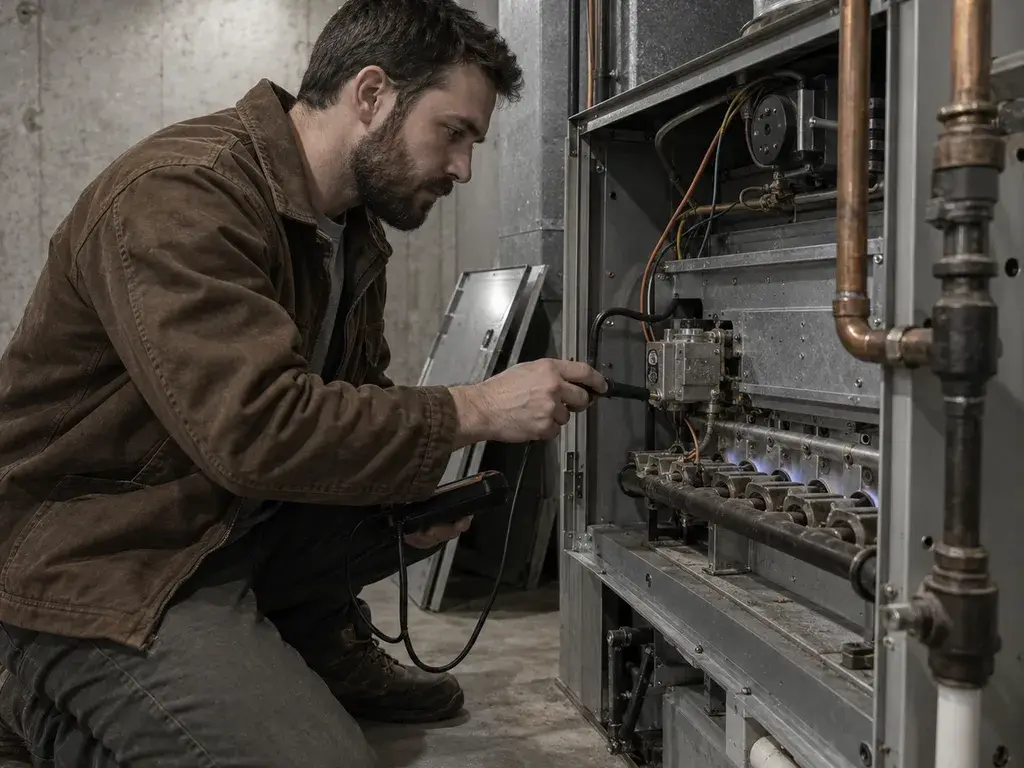
A system that has stopped making heat on a cold night has one of a short list of faults behind it, and the step where the sequence stops names the part. Say what heats the house, what the thermostat is asking for against what it says the room is, and what the equipment is actually doing, and a heating contractor who covers Chimney Point takes it from there.
A winter this length runs both halves of the system hard, and both age on the same clock. The furnace and the air conditioner usually share one blower, one filter and one set of ducts, so what the cooling season did shows up when the blower has to move heated air again.
The fault list is short: flame sensor, ignitor, pressure switch, limit switch, a filter starving the blower, a thermostat that lost its common wire. What tells them apart is the order the equipment runs in — the inducer spins up first, the pressure switch proves it, the ignitor glows, the gas valve opens, and the flame has to prove itself within seconds. A technician follows that order at the appliance, and the call is what puts one in front of it.
In the Northeast far more houses heat with a boiler than anywhere else in the country, and in Chimney Point a no-heat call is as likely to be about radiators or baseboard as about a furnace. The fault list is a different one: pressure too low for water to reach the top floor, a circulator pump that hums without moving water, air trapped in the lines so the upstairs radiators stay cold, a zone valve stuck shut, an expansion tank that has lost its charge. A dripping relief valve, or a pressure gauge climbing toward 30 psi, is a reason to call rather than to wait: the boiler is holding more pressure than it should.
Chimney Point, CT in numbers
| Days a year with a low of 32°F or colder | 126 | NOAA 1991–2020 normals, station 7 miles away |
|---|---|---|
| Days a year with a low of 20°F or colder | 46 | NOAA 1991–2020 normals |
| Average July dew point | 62°F | PRISM 1991–2020 normals |
| Households | 61 | Census ACS 2019–2023 |
| County | Western Connecticut Planning Region | Census Bureau |
| Federal minimum for a new split central AC | 13.4 SEER2 (North region) | DOE, 2023 standard |
Why heating faults do not fix themselves
The fault that changes the whole conversation is a cracked heat exchanger. It is not a repair question alone — the gas utility red-tags the appliance and shuts the supply off, and it restores the supply only after a licensed contractor has worked on the furnace. Flipping the switch changes nothing about the tag, and taking the tag off gets rid of the record of what was found.
A heating tune-up before the season
No tune-up promises a winter without a call, and a visit that finds nothing wrong has still told you the age and condition of the parts that fail first. It is a one-time visit. A service agreement is a separate decision, and booking the first does not require the second.
When to stop and call in Chimney Point
- There is a smell of gas, or a carbon monoxide alarm has gone off — outside first, then the gas utility, then the repair call.
- There is a tag on the furnace and the gas supply has been shut off.
- The blower runs and the air never warms, or the thermostat is asking for heat while the reading keeps dropping.
- The license
- Held by the contractor, not by this site, and issued where the work happens — Connecticut licenses at state level, at city level or not at all depending on the trade and the town. Ask for the number and the name it is held under: a trading name and the licensed entity are often not the same.
- The figure
- Set by the contractor and said before the work starts. This site never quotes and has no part in it. If a technician cannot say what the visit covers before beginning, that is the moment to stop.
- The call
- Describing what the system is doing commits you to nothing. Nothing is booked until you say so.
What the visit involves
- 01
The diagnosis
At the thermostat first, then at the furnace or the condenser, in the order the equipment runs. What the system is doing is established before any part is named.
- 02
The repair
Agreed with the contractor before it starts. Where a part has to be ordered, a technician says so rather than leaving the system apart.
- 03
What happens after
A system that failed once in a season often fails again in it. Whether that is the same fault or a second one is worth asking while the technician is still there.
What to have ready when you call
- 01What the system is — a furnace, a boiler on radiators or baseboard, or a heat pump with electric backup.
- 02When the system went in, as near as anyone knows, and the model and serial number off the data plate inside the cabinet door — the year is usually in the serial rather than printed as a date.
- 03The two thermostat numbers: the setting, and the reading it shows for the room — and whether the screen has gone blank, because a thermostat wired without a common wire runs off its battery, and a dead battery looks exactly like a dead furnace.
Do not keep pressing the reset while you wait — each press relights a furnace that shut itself down for a reason, and the lockout it is holding is the first thing a technician reads.
Heating Repair in Chimney Point: questions
How cold does Chimney Point get in winter?
Chimney Point averages 126 days a year with a low of 32°F or colder and 46 at 20°F or colder, by the 1991–2020 climate normals for a NOAA station 7 miles away. Both halves of the system work hard here, and the heating side runs for months rather than weeks.
What does a red tag on a furnace in Chimney Point mean?
The gas utility red-tags a furnace when it finds a leak or an unsafe appliance, and it shuts the gas off to it. Gas comes back only after a contractor repairs the fault; a cracked heat exchanger is the finding that most often turns the repair into a replacement.
Other services in Chimney Point
Heating Repair nearby