Billings, MO
Heat Pump Repair and Replacement in Billings
A heat pump blowing air that feels cool in winter is usually working as designed, and a heat pump that sits on auxiliary heat for hours in mild weather usually is not. Say what the thermostat is showing and a heating and cooling contractor can come out to Billings and tell the two apart.
(888) 217-3739Missouri contractors. No obligation for the call.
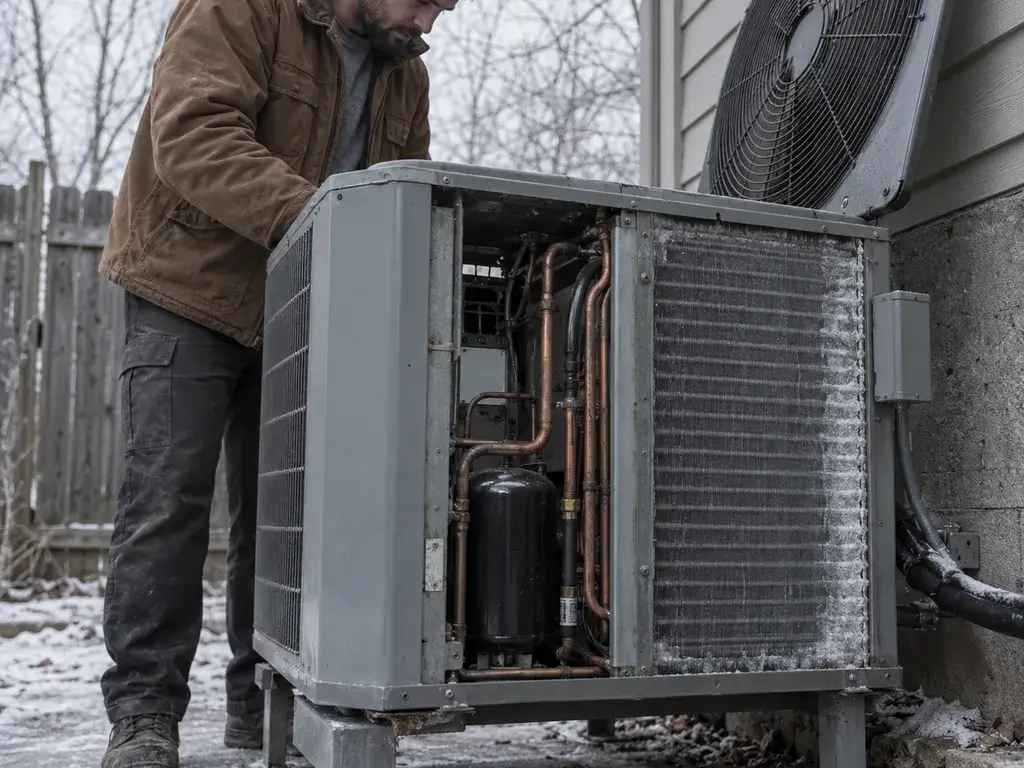
In Billings a heat pump carries most of the year by itself, cooling through the summer and heating through everything except the coldest weeks. That is the argument for one, and it is also what ages it: the compressor, the contactor and the capacitor take run hours an air conditioner in the same house would never see, which is why age on a heat pump is better counted in seasons worked than in years on the data plate — a system installed in 2012 that has worked both halves of every year since is further along than the date suggests.
Where a furnace and a separate AC are two machines, one can fail and the other carries on: the furnace goes and the cooling still works all summer. A heat pump is both of those machines in one cabinet, so when the compressor goes, heating and cooling go together, and the decision that arrives is not about half a system. A climate with two real seasons leaves no long off season to push it into — the machine is wanted again within weeks, whichever way the weather is going.
The reversing valve gets tested twice a year, when the machine changes direction — once in autumn and once in spring. A machine that heated all winter and then refuses to cool when the first warm week of May arrives is usually pointing at that valve, or at the control that tells it to move, rather than at the compressor. A spring failure is easy to put off, and that is the trap: the valve that would not move in May is the valve that has to move again in October, and a summer of leaving it alone does not fix it.
The frost on an outdoor coil comes out of the air, not off the ground, which is why the heaviest of it here arrives in weather nobody would call severe. A coil below freezing collects moisture from damp air faster than from cold dry air, so a drizzly morning near 35°F puts more ice on it than a clear night at 15°F does — and a defrost cycle on a mild wet morning is the machine keeping up rather than falling behind. Ice that is still sitting there at the end of the day is the fault version, and it does not clear itself.
Nights below 20°F come often enough here that the auxiliary strips do real work, so a January bill above October's is the equipment behaving as designed rather than a fault. The version worth knowing about is a failed element inside that bank — several elements share one breaker, so the rest carry on, the house falls behind only on the coldest nights, and the heat pump itself tests fine.
Why heat pumps do not fix themselves
A heat pump is unusual in that it can fail without going quiet. A machine low on refrigerant, or one whose defrost control has stopped working, does not stop making heat — it falls behind, and the backup heat fills the gap without being asked. The house stays at the setting, so the fault reports itself on the electric bill instead of at the thermostat. In cooling the same shortfall is easier to spot, because nothing covers for it — which is why a heat pump often gets diagnosed in summer for something it had been doing all through the heating season.
The parts that cycle fail first, and they rarely fail alone. A run capacitor that has lost capacitance does not shut the compressor down — it raises the current the compressor draws every minute it runs, and the heat that comes with it. A heat pump asks for that on both sides of the year, where an AC only ever runs to cool, so the part that fails at the end of it is not the capacitor. A capacitor is a part; a compressor is a large fraction of the machine, and on a system installed before 2010 that is where the conversation turns to replacement.
A leak that gets fed rather than found is the version of this that repeats. Refrigerant is not used up, so a system that took a charge last season has a hole in it somewhere, and on a heat pump the shortfall that was mild in August is worse in January, when the machine has the least capacity to spare. Each season it gets topped up it empties again from the same place, and a compressor running under-charged runs hotter than it was built to — refrigerant is what cools it.
What the store-bought fix actually does
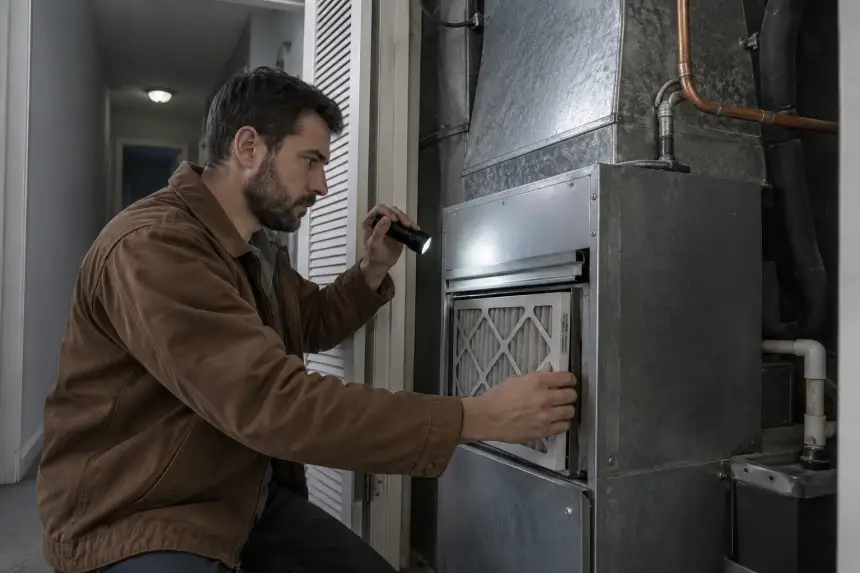
The filter is the one thing on this list where the store-bought version does real work: a loaded filter starves the indoor coil of air, and a clean one gives that back. What it cannot do is explain a house that is still behind — a furnace with restricted airflow trips its limit switch and announces itself, while a heat pump never makes air hot enough to trip anything: it falls behind, the backup strips make up the difference, and nothing announces anything. That is why a fresh filter settles nothing by itself: the charge, the defrost control, the reversing valve and the capacitor all sit behind it, and none of those is sold on a shelf.
The small can with a gauge on the top is a car product, and that is not an accident: a homeowner cannot buy R-410A or R-454B over the counter. The EPA restricts the sale of those refrigerants to certified technicians, and refrigerant for a car air conditioner is the exception that keeps the can on the shelf. Even where a fitting could be made to work, a technician sets the charge by measurement rather than by a gauge reading — superheat and subcooling, read at the machine, and read differently in heating mode than in cooling. And a working system does not consume refrigerant: a heat pump that needs more of it has a leak, so the work is finding the leak rather than replacing what escaped.
A hard-start kit does what it says on the box, and that is the problem with it. It adds starting torque, and a compressor that has begun to struggle will often run another season with one fitted — it is a real part, fitted deliberately on some systems, and not a gimmick. What it does not do is explain why the compressor needed help: a weak run capacitor, worn windings, or a system running at pressures it should not be. A kit fitted and then forgotten hides that question until the compressor answers it.
When to stop and call
- Ice covers the outdoor coil and the defrost cycles are not clearing it.
- The thermostat sits on auxiliary or emergency heat for hours while it is mild outside.
- It cools in summer but will not heat, or it heats but will not cool.
- The breaker feeding the outdoor unit or the air handler will not stay in.
- Refrigerant was added in an earlier season and the system is behaving the same way again.
- The license
- Held by the contractor, not by this site, and issued where the work happens — Missouri licenses at state level, at city level or not at all depending on the trade and the town. Ask for the number and the name it is held under: a trading name and the licensed entity are often not the same.
- The figure
- Set by the contractor and said before the work starts. This site never quotes and has no part in it. If a technician cannot say what the visit covers before beginning, that is the moment to stop.
- The call
- Describing what the system is doing commits you to nothing. Nothing is booked until you say so.
- Coverage
- By town, not by region. Billings and the towns around it, and it shifts with who is taking calls at the hour you ring.
What the visit involves
- 01
The diagnosis
At the thermostat first, then at the furnace or the condenser, in the order the equipment runs. What the system is doing is established before any part is named.
- 02
The finding, out loud
What failed, whether it is the fault or a symptom of another one, and whether the repair suits the age of the system. A diagnostic visit is usually charged separately from the repair — ask whether it is credited if the work goes ahead, because that differs from one contractor to the next.
- 03
The repair
Agreed with the contractor before it starts. Where a part has to be ordered, a technician says so rather than leaving the system apart.
- 04
What happens after
A system that failed once in a season often fails again in it. Whether that is the same fault or a second one is worth asking while the technician is still there.
What to have ready when you call
- 01That it is a heat pump, and what the backup is — electric, or a gas furnace on the same ducts, and not knowing is a fair answer.
- 02What the thermostat is set to, what it is reading, and whether it shows auxiliary or emergency heat.
- 03Roughly what year it went in, and the refrigerant from the outdoor data plate — R-410A on most systems in service, R-454B on recent ones.
- 04What the outdoor unit is doing: iced over, silent, running without stopping, or reversing every few minutes.
- 05The address and ZIP code, and whether the outdoor unit can be reached — a locked gate, a dog or deep snow changes the appointment.
If the house has gone cold, emergency heat is what that setting is for — say on the phone that you switched to it, because it locks out the compressor, and the fault a technician needs to watch stops happening while it is on.
Other services in Billings
Heat Pumps nearby