Bijou Hills, SD
Furnace Replacement and Installation in Bijou Hills, SD
Replacing a furnace in Bijou Hills, SD starts with sizing the new one to the house rather than copying the label on the old one. Bijou Hills averages 167 days a year with a low of 32°F or colder and 90 at 20°F or colder (NOAA 1991–2020 normals, station 5 miles away). The federal minimum for a new non-weatherized gas furnace is an AFUE of 80, and a 95 standard for furnaces made after December 18, 2028 is still in court.
(888) 217-3739South Dakota contractors. No obligation for the call.
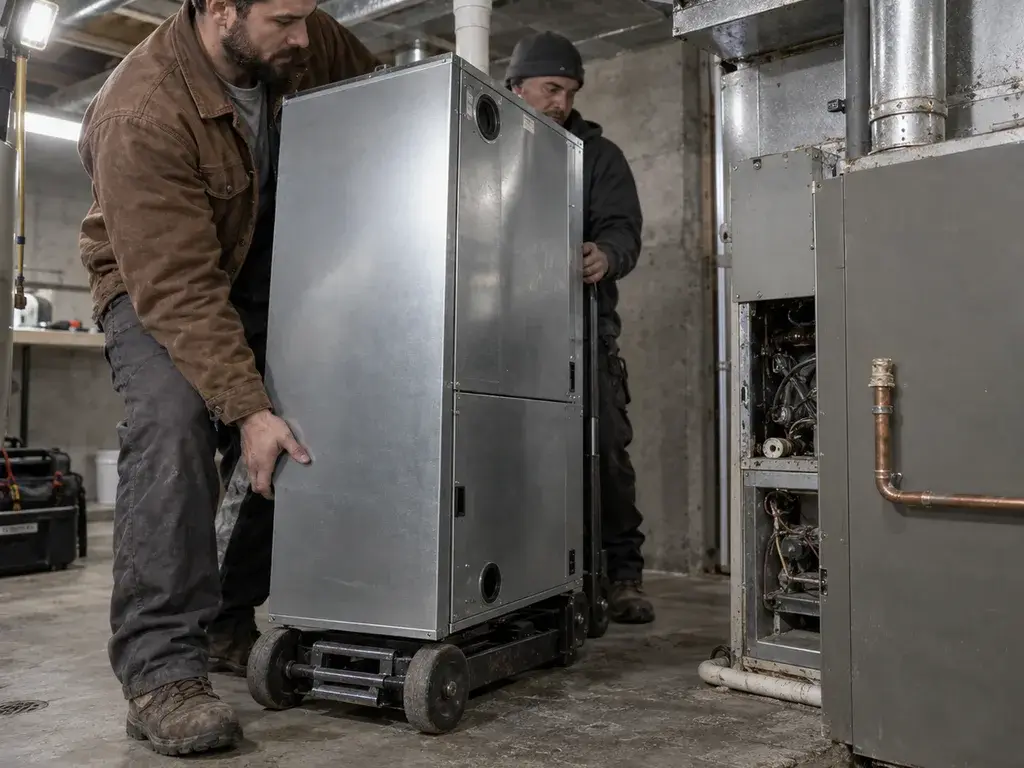
A furnace that has failed once and a furnace on its second service call this season are two different questions. Say when it went in, roughly, and what it is doing now, and a heating contractor can come out to Bijou Hills and answer that before anything is ordered.
The furnace is the main system in Bijou Hills, and it runs a full season rather than a few cold snaps. That is what sets the clock on this question: a furnace here runs up heating cycles faster than the same appliance in a milder place, and the heat exchanger is the part that keeps the count.
The steel expands every time the burners light and contracts every time they stop, and a crack is where that ends. That is not a failed part: the heat exchanger is the body of the machine rather than something bolted to it, and getting at one means stripping the furnace back to its cabinet. By then most of the decision has been made for you.
A changeout is the one visit where a second question is genuinely open, and nights below 20°F come often enough here to put it there: another gas furnace, or a heat pump with the furnace kept behind it. On those nights a heat pump working alone hands the shortfall to electric resistance strips, and the electric bill follows. What a contractor means by dual fuel is keeping the furnace as the backup instead of strips, and the thermostat, the wiring and the gas connection are all apart on changeout day anyway.
Bijou Hills, SD in numbers
| Days a year with a low of 32°F or colder | 167 | NOAA 1991–2020 normals, station 5 miles away |
|---|---|---|
| Days a year with a low of 20°F or colder | 90 | NOAA 1991–2020 normals |
| Average July dew point | 61°F | PRISM 1991–2020 normals |
| County | Brule County | Census Bureau |
| Federal minimum for a new split central AC | 13.4 SEER2 (North region) | DOE, 2023 standard |
Furnaces do not fix themselves
Money spent on an old furnace does not move across to the new one. A large repair on an appliance installed before 2010 buys months rather than years — and if the fault turns out to be the heat exchanger, the gas utility takes the timing out of it altogether: it closes the supply, and the supply comes back only after a licensed contractor has worked on the appliance.
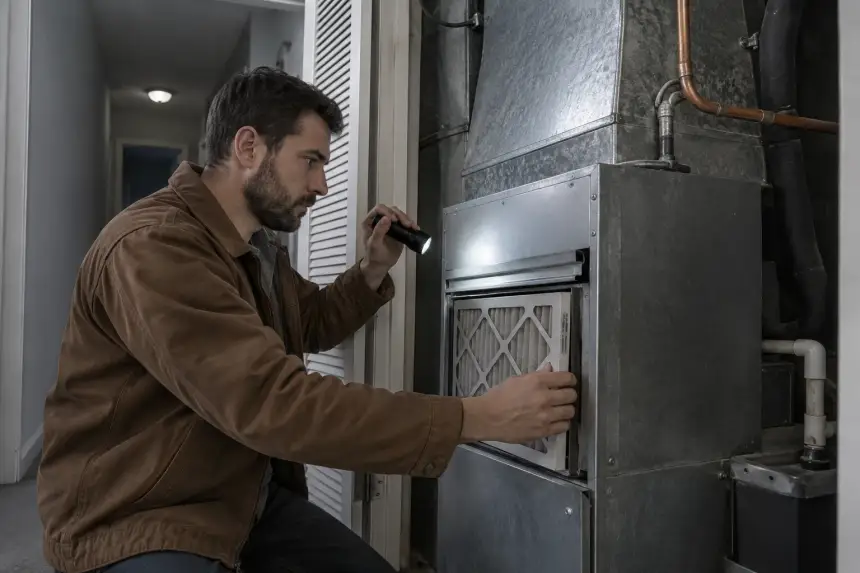
When to stop and call
- The gas utility has tagged the furnace and shut the supply off.
- A technician has said the words heat exchanger, or a carbon monoxide alarm has gone off.
- Flame rolls out of the burner opening, or there is soot around the furnace door.
- The license
- Held by the contractor, not by this site, and issued where the work happens — South Dakota licenses at state level, at city level or not at all depending on the trade and the town. Ask for the number and the name it is held under: a trading name and the licensed entity are often not the same.
- The figure
- Set by the contractor and said before the work starts. This site never quotes and has no part in it. If a technician cannot say what the visit covers before beginning, that is the moment to stop.
- The call
- Describing what the system is doing commits you to nothing. Nothing is booked until you say so.
What the visit involves
- 01
The diagnosis
At the thermostat first, then at the furnace or the condenser, in the order the equipment runs. What the system is doing is established before any part is named.
- 02
The repair
Agreed with the contractor before it starts. Where a part has to be ordered, a technician says so rather than leaving the system apart.
- 03
What happens after
A system that failed once in a season often fails again in it. Whether that is the same fault or a second one is worth asking while the technician is still there.
Before you call: what to have ready
- 01When the furnace went in, roughly, and its model number — the data plate inside the door carries both.
- 02Whether the gas utility has already been there, and the wording on the tag — the tag usually names the component.
- 03Whether cooling runs through the same ductwork, and what the outdoor data plate gives as the refrigerant — R-410A, R-454B or R-22 — and the model number on that unit, which tells a contractor whether it only cools or heats as well.
The data plate inside the furnace door answers half the call, so have it in front of you — the year it went in and the model number. And if the gas utility left a tag on the appliance, leave the tag where it is: it names what has to be put right before the gas comes back.
Furnace Replacement in Bijou Hills: questions
How cold does Bijou Hills get in winter?
Bijou Hills averages 167 days a year with a low of 32°F or colder and 90 at 20°F or colder, by the 1991–2020 climate normals for a NOAA station 5 miles away. Heating is the main system here, and a furnace that quits in January is an emergency rather than an inconvenience.
Is there still a federal tax credit for a new furnace?
No. The 25C energy efficient home improvement credit ended for equipment installed after December 31, 2025, under the tax law signed on July 4, 2025. A quote that subtracts it is out of date, and any utility or state rebate is a separate program to ask the utility about.
Other services in Bijou Hills
Furnace Replacement nearby